

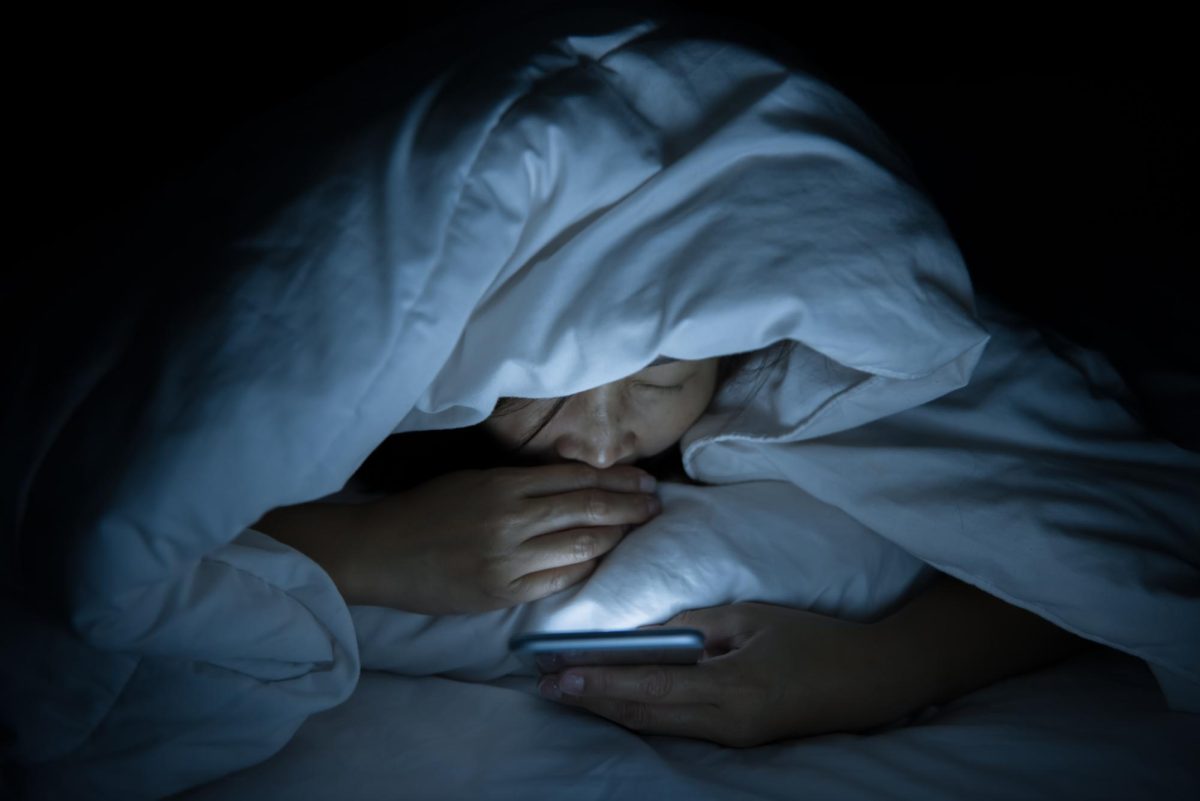
Do you ever wake up in the morning and still feel tired? Then remember you were aimlessly scrolling on social media with your device shining right in front of you the previous night? Research by Ishizawa and colleagues, published in Sleep Medicine, suggests that blue light exposure, otherwise known as the light that emanates from electronics, is affecting adequate sleep quality.
In the study, 11 young healthy men were selected to look at the consequences of blue light exposure before bedtime. Blue light sources include cell phones, laptops, TVs and more. The study was conducted in the participants’ room one hour before they went to sleep.
Participants were exposed to three types of lights while reading at a desk. The three conditions were incandescent light, blue light and blue light with blue-light blocking glasses. Incandescent light is a type of light that produces a warmer white/yellow color.
Blue-light glasses usually function by reflecting or absorbing the blue light being emitted to help reduce eye strain and improve sleep. They conducted the study using a mat-type sleep reader which is a device that lays like a mat under the mattress and utilizes sensors to track motion.
This study tracked the many different stages of sleep. Light sleep is the initial stage where our minds begin to relax and is the transition into deep sleep which allows the brain to regenerate and function properly. Then, our brain also goes into a state of Rapid Eye Movement sleep (REM). During this state, our bodies are able to unify memories and process new things.
Each candidate was instructed to wake up naturally without an alarm. Results showed no significant distinction between total sleep time, REM and light sleep in the three different conditions. However, the amount of deep sleep decreased when participants were exposed to blue light, which was detrimental to sleep quality.
Sleep quality is crucial to all — especially college students. Deep sleep allows our body and mind to rest, regenerate and relax. Students spend many nights staying up late to cram for a test or maybe sneaking in their favorite TV show. However, these actions are proven to have consequences.
This study concludes that blue-light exposure is potentially reducing sleep quality by disturbing deep sleep. Blue-light exposure studies are still in the works, and further studies must be conducted to understand the full impact across all ages and genders.









Paul Shuler • Jan 8, 2026 at 7:41 pm
Great article!