

“My employer is morally bankrupt.”
That’s what the sign across Charlie Kurth’s office door read following the firing of three Clemson University faculty members for comments they made in the wake of conservative political activist Charlie Kirk’s assassination.
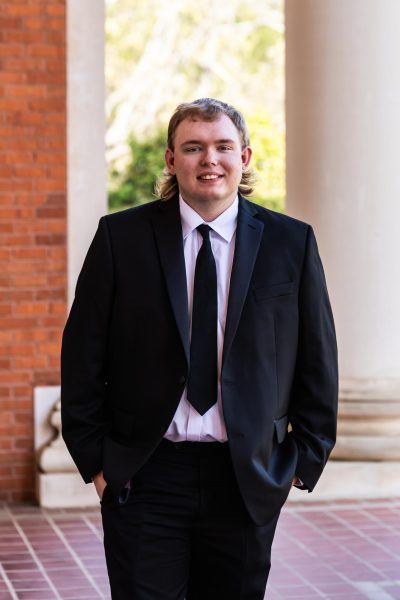
Representatives from the Foundation for Individual Rights and Expression visited Clemson on May 6 to award Clemson philosophy professors Kurth and Mike Gregory the Berkson Courageous Colleague Award. FIRE is a nonprofit, nonpartisan civil liberties group that brands itself as defending free speech, conscience and thought across the United States.
Kurth and Gregory spoke up about the University’s termination of the three employees, attracting FIRE’s attention and ultimately earning them the awards. FIRE told Kurth and Gregory in an email that the two were receiving the award for “speaking out in defense of your colleagues who were fired by Clemson University for their social media posts about Charlie Kirk’s shooting.”
‘A voice of reason’
As far as putting the sign on his door, Kurth told The Tiger that the faculty firings were like “the straw that broke the camel’s back for me,” referring to the University’s “mission-critical” expenditure mode announced in January 2025. He believes these increased budgetary constraints led to “ill-thought-out decisions by upper-level administrators” and cited the cutting of faculty research funding.
A photo of the sign quickly made its rounds on social media, even garnering the attention of former South Carolina House Rep. Adam Morgan. Kurth said reactions were mixed.
“I don’t know who took the picture that ended up getting me doxxed, so obviously some people were upset and thought what I was doing was inappropriate, and so there was that dimension of it,” he said. “Other students approved of it.”
Kurth added that he also received many emails expressing “blunt, offensive, aggressive displeasure” with what he had written.
While Kurth’s sign was his way of voicing his displeasure with the firings, Gregory opted for a different route, instead publishing an op-ed in The State in his effort to speak out against Clemson.
“I looked around and saw the amount of defeat in the eyes of a lot of the faculty around me,” Gregory told The Tiger. He wanted people to know that a “voice of reason” existed — one that said what he believed other faculty members at Clemson were feeling.
Gregory said that, like Kurth, he received mixed reactions after publishing his op-ed. However, he felt responses from students and faculty were mostly positive, with most negative ones coming from people outside of the University.
Alongside their individual efforts to speak out against the University’s decisions, the two professors worked together to co-write an article for the Chronicle of Higher Education titled “Who Will Clemson Censor Next?”
With their on-campus offices just a few doors apart, conversations about the firings eventually led to the two collaborating on the article.
“Because we were met with silence and the University wasn’t doing anything,” Gregory explained, “we decided that the only thing to do would be to write something together that really tried to push Clemson to acknowledge the kind of damage that they had done to their own faculty by these firings.”
Kurth added that he felt a “culture of fear” was growing across Clemson in ways the two found disturbing, prompting them to draw attention to the matter.
‘I thought that I was going to lose my job’
Beyond reactions from students, faculty, and government officials, Kurth and Gregory’s actions also elicited internal responses from higher-level officials within the University. Those responses left both Kurth and Gregory uncertain about whether they would remain employed by the University or if they, too, would be fired.
Kurth said that, shortly after the sign went viral on social media, he received a call from Benjamin White, an associate professor at Clemson and chair of the department of philosophy and religion.
“One of my questions was, ‘Am I going to have a job on Monday?’ And the response was just sort of vague,” Kurth told The Tiger.
Gregory mentioned that, unlike Kurth, he is not a tenured professor, which heightened his fears of potential retribution from the University.
“There was about three or four weeks where I was told that the board of trustees was discussing my employment and had thought about opening an investigation into my conduct,” he said. “I thought that I was going to lose my job.”
However, both professors remain employed by the University.
Both Kurth and Gregory said that they were humbled to receive the award from FIRE, with Gregory adding that it “was nice to people to see that and be aware of the actual cost that me and Charlie gave to try and stand up to what we saw as an injustice on the part of Clemson.”
Kurth said he’s disappointed that the University hasn’t recognized the awards, Gregory adding that the two “were told explicitly that the University wasn’t gonna cover it, and that we shouldn’t expect any comment.”
University spokesman Joe Galbraith did not respond to The Tiger’s request for comment by publication.
Both professors said they understood the risk they were taking by speaking up. As for any other students or faculty who may feel compelled to take similar actions on other issues, the two emphasized the importance of understanding those risks and whether they can afford to take them.
Both professors believe in the importance of pushing for change when it comes to issues people are passionate about.
“Know that it costs something, and think about that,” Gregory said, “but also know that there are unforeseen benefits often to sort of breaking the spell of fear and letting people know the king can bleed.”