
As well-resourced as Clemson is, it has not been spared from a social issue facing communities nationwide: how to support people experiencing homelessness.
Though often unseen or unheard, individuals without housing continue to survive throughout the city, even in the harsh conditions of recent winter weather.
“In the five years that I’ve been here — and from what I was told before that — there’s always been a homeless population in Clemson,” Clemson Police Chief Jorge Campos told The Tiger in an interview. “It ebbs and flows based on what’s going on in the city.”
Campos said the city’s homeless population is not large in comparison to other areas, but its presence is consistent. Much of the population remains hidden, contributing to the misconception among some residents that homelessness is not a local issue.
That perception contrasts with county-level data. In the 2025 State Homelessness Report, 2,642 children in Pickens County experienced homelessness last year — the highest number of any county in South Carolina.
For Colleen, an employee at The Salvation Army store in Clemson, the scope of the issue only became clear after she began working directly with the homeless population.
“When I first came to Clemson, I didn’t even know there was a homeless problem,” she said. Now, she sees it every day.
Located in one of Clemson’s most active and supportive areas, The Salvation Army store has become a consistent stop for individuals without housing who are seeking access to donated clothes, charging outlets and other basic necessities.
“That’s what we’re here to do, support and help the homeless,” Colleen continued. Still, she said the lack of a unified support system in the area leaves people with few options for survival: “It’s just us; there is no support in the area.”
Without a centralized shelter or coordinated care system, Colleen said unhoused individuals often sleep in wooded areas, public spaces or even on The Salvation Army’s roof, using only pillows and blankets for warmth.
Seasonal conditions further complicate survival for these individuals. While Clemson’s winters are relatively mild, cold nights and snowstorms prompt people to seek safer locations when available, including emergency shelters during extreme weather conditions.
Colleen also expressed concern about safety within the community. She said homeless-on-homeless crime is common, particularly when someone has food, money or other supplies.
“If someone has something, they’re a target,” she told The Tiger.
After seeing news coverage of someone struck by a train, Colleen shared her concerns that it might have been one of the unhoused locals who often stops by Salvation Army.
“It’s horrifying,” she said, emphasizing that she fears for the population’s safety each day.
Advocates say the conditions facing the homeless population in Clemson are largely driven by economic pressures rather than individual failure. Rev. Nath Briley, executive director of Family Promise of Pickens County, cited rising housing costs paired with stagnant wages as the primary contributors to homelessness in the area.
“The other two big issues that really affect homelessness are the cost of living and the cost of housing,” Briley told The Tiger. “It’s gone up high, and our pay has not. There’s a big gap there.”
That gap persists even for people who are employed, Briley said. Many work one or more jobs, yet still cannot afford rent.
“A lot of people think they shouldn’t have food stamps because they need to be working,” he said. “Well, they’re working. Some of them are working two jobs and still can’t make up that gap. The gap’s real.”
Government assistance programs help in certain situations, Briley added, but they are often insufficient to bridge the growing affordability divide.
Another major barrier cited by local leaders is the lack of intra-county transportation. While resources exist throughout Pickens County, access to them is limited for people without a vehicle.
“There is no public transportation between here and Pickens,” Campos said. “Unless somebody is giving them a ride back and forth, they’re not going up there. A lot of the county resources are in Pickens, but they don’t have transportation to get to and from there.”
Public transit is available in the Clemson and Central areas, but not beyond.
“If you live in our county and you don’t have a car, you’re in trouble,” he said. “That’s a big issue.”
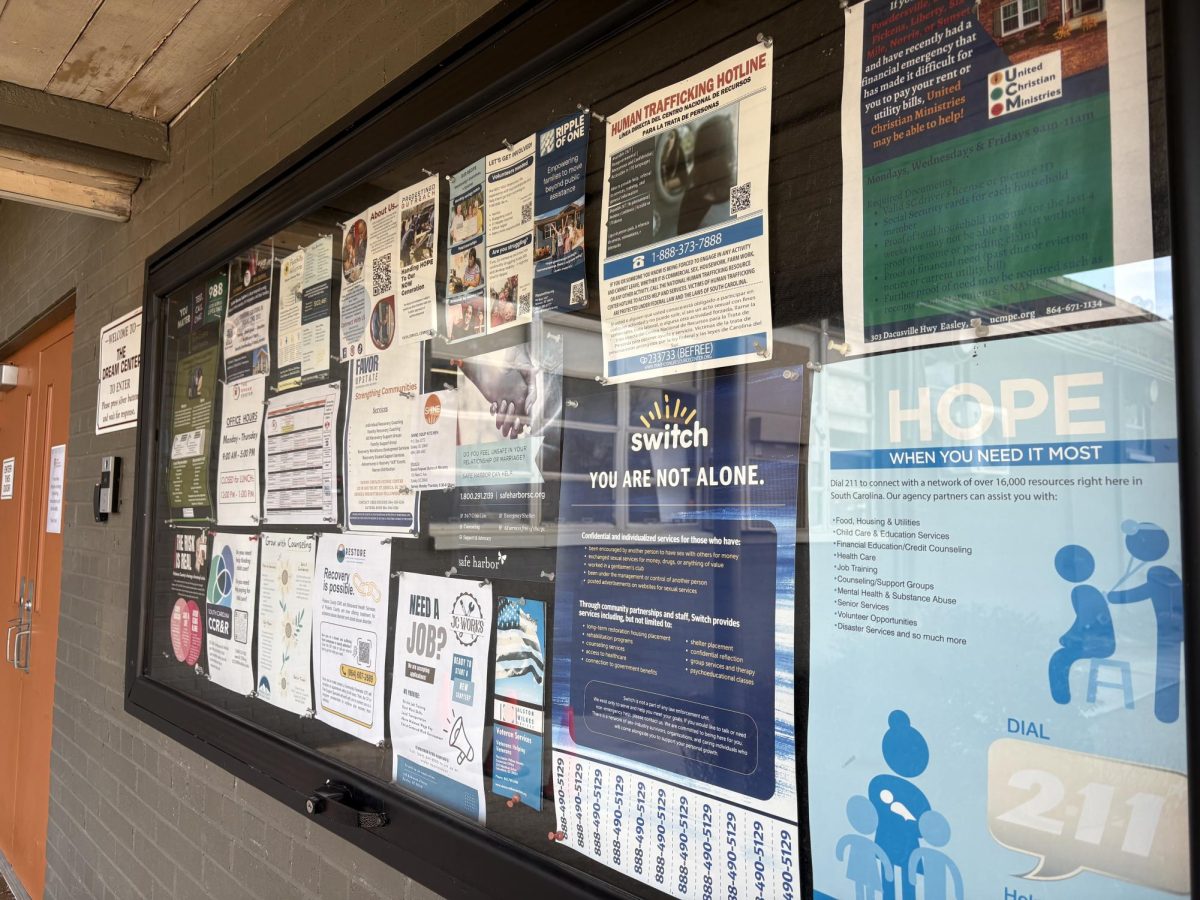
As a result, people without housing in Clemson often rely heavily on local organizations such as The Salvation Army, Clemson Community Care and volunteer-led initiatives.
Campos also emphasized that homelessness is not a single story. While some people experience homelessness due to economic hardship or crisis, others choose to live without homes.
“There’s a whole perspective of who these folks are and why they are where they are,” Campos said. “Some are down on their luck, but some — that’s the lifestyle they choose to live.”
Because of individual freedom, he said, assistance cannot be forced.
That distinction creates tension between public perception and legal reality, Campos continued, particularly when residents call police to remove homeless individuals from public spaces.
“They’re U.S. citizens,” he told The Tiger. “They have the right to use public amenities as long as they’re following the rules.”
Tim Conrad, a Pickens County advocate with Upstate Warrior Solutions, shared a similar example illustrating the complexity of the issue.
“I have a veteran who’s a retired lieutenant colonel,” Conrad said. “He’s V.A. 100% disabled. He probably makes about seven grand a month, but he doesn’t want to live in a house. He wants to sleep in the woods. There’s nothing I can do for that guy.”
Despite the challenges, local leaders emphasized that Clemson is not lacking compassion.
“I think within the counties and the cities, we have plenty of resources,” Conrad said. “Food, people cooking meals twice a day, emergency shelters when it gets extremely cold or hot. The community in Clemson really comes together.”
College students frequently give money and supplies, and nonprofits continue to offer outreach efforts. Clemson Community Care serves as a major resource hub, providing food, transportation, toiletries, blankets and clothing. The organization also offers a small deposit assistance program for individuals who are working, but fall just short of securing housing.
Lauren Russell, program director at Clemson Community Care, said that affordability remains the largest obstacle: “The biggest need is more affordable housing.”
Looking ahead, local and state leaders are exploring policy solutions. Rep. Claiborne Linvill is scheduled to present a proposal to the Pickens County Council outlining an affordable housing tax credit policy, which she said will inform her work at the state level.
Additional efforts are underway to strengthen recovery and outreach services. A grant application has been submitted to support a partnership with FAVOR Upstate, along with SCORE grant funding to expand outreach efforts, according to Campos.
Campos urged residents to focus their efforts through established organizations rather than individual aid.
“When people want to help, they should pour into the community resources that exist,” he said. “That’s how we make a real impact.”
Community leaders are also calling for greater participation in the annual Point-in-Time Count, a federally mandated effort to estimate the homeless population.
Conrad said more volunteers are needed to collect data. Briley, Conrad, Mayor Robert Halfacre and the city police work together to identify the population, but “that’s not enough.”
The count is particularly challenging in Clemson, where mild winter temperatures allow some people to remain unsheltered, making them harder to identify and reach. This is a complication that The Tiger found as well when trying to contact the local homeless population.