
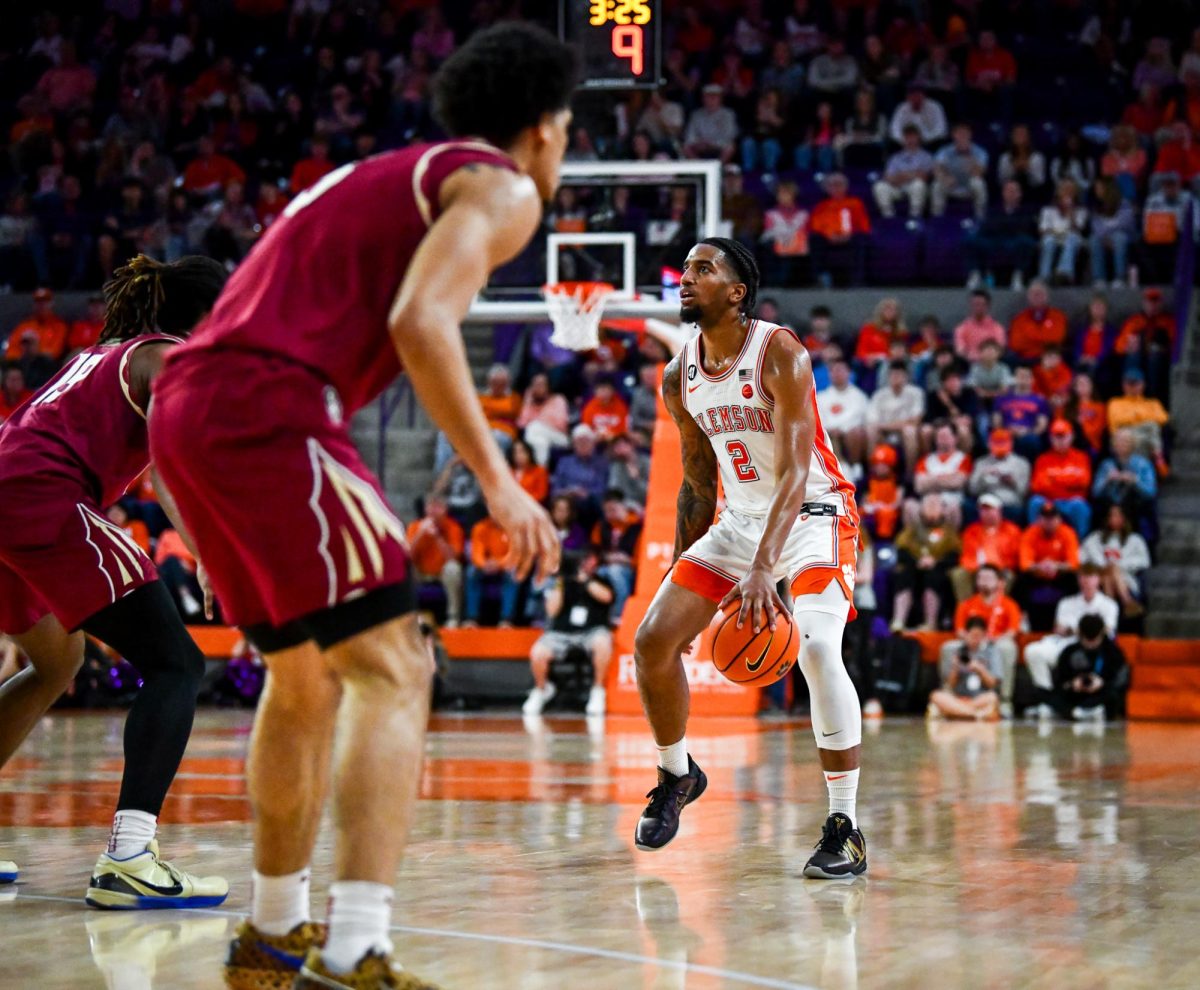
When Clemson takes on No. 24 Louisville this Saturday at Littlejohn Coliseum, it will mark 21 days since the Tigers’ last victory. That last win came on Feb. 7, when Clemson completed its two-game West Coast trip against California.
Since returning from the West Coast, the Tigers have lost four straight games by a combined 36 points. Before the beginning of the skid, the Tigers had lost just four games all season.
The streak began on Feb. 11 with a 76-66 loss to Virginia Tech. On paper, there was no clear change for then-No. 20 Clemson, as the Tigers shot nearly their season average from the field and beyond the arc. The rebounds were level, too, as Clemson was only outrebounded by two rebounds.
In the first half, the Hokies were feeling themselves beyond the arc, draining seven 3-pointers to the Tigers’ two. The biggest shift, though, came in the second half.
Clemson shot 53.6% from the field and 40% from 3-point land in the first half. Those percentages fell to 37% and 27.3%, respectively, in the second half. For a team that averages nearly 9% better than that from the field, it was a fall off the Tigers could not afford.
Dillon Hunter and RJ Godfrey, Clemson’s two scoring leaders, scored just a combined 7 points in the contest despite averaging 7.7 and 11.5 points per game, respectively. The team’s leaders’ lack of production ultimately led to the loss.
It could be easy to blame the West Coast swing for the defeat, but head coach Brad Brownell was adamant in his post-game remarks that the trip was not to blame.
“I don’t want the story to be that Clemson came back from the West Coast and whatever,” he said. “We got beat by a good team tonight who outplayed us.”
The Tigers hoped to bounce back on Valentine’s Day in a pivotal game against then-No. 4 Duke that would determine the leader of the ACC. That didn’t happen.
Instead, Clemson shot just 35.1% from the field and 25% from beyond the arc; both averages were down severely from the team’s season average. Poor shooting left the Tigers unable to pounce on Duke’s similarly poor performance, as the Blue Devils shot 42.6% from the field and 34.5% from 3-point range.
Once again, Hunter and Godfrey were shut down in a similar fashion during the game against Virginia Tech, scoring just a combined 14 points in the contest. Carter Welling again led the scoring for the Tigers, but with just 12 points, no player was able to take over the game for Clemson and become the clear No. 1 option.
The game ended 67-54, marking Clemson’s worst loss of the season thus far. When the AP Poll rankings were released two days later, the Tigers had dropped out of the top 25, though they received the most votes among teams left unranked.
Clemson then traveled to Wake Forest on Feb. 18, taking on a team that sat just 4-8 in ACC play. The game presented itself as the perfect opportunity for the Tigers to finally right the ship.
Instead, that ship sank, as Clemson dropped its third straight game, 85-77. Once again, the Tigers’ top scorers were almost nonexistent, with Godfrey scoring 8 points while Hunter put up just 3.
The Tigers actually shot above average from the field at 46.4% and were just under their average 3-point percentage at 30.8%. Where the game fell apart this time was on the defensive side of the ball.
Clemson’s opponents this season have averaged 65.6 points per game, 41.2% from the field and 31.5% on 3-pointers. Wake Forest put up 85 points and shot 54.9% from the field, as well as 45.5% from beyond the arc.
To put those percentages into perspective, the Demon Deacons’ field goal percentage was 33.3% higher than the Tigers typically allow, and the 3-point percentage was 44.4% higher. For a Clemson team that was once poised to be a five or six seed at the start of February, that type of defensive performance is inexcusable.
Those defensive woes carried over into the game against Florida State, a team on a hot streak that had won six of its last eight games heading into the Feb. 21 contest in Littlejohn.
This time, the Tigers fell 70-65, allowing the Seminoles to shoot 50% from the field and 41.7% from three. After a better offensive showing against Wake Forest, the offensive slump returned.
Clemson shot 30.3% from beyond the arc, close to its season average. The shooting from the field made all the difference, as the Tigers shot well below average at 37.5%.
Hunter and Godfrey produced their highest scoring numbers of the four-game slide, though, putting up 13 and 12 points, respectively. Ace Buckner was the game’s leading scorer with 15 points.
So far this season, Clemson has six players, which is more than a starting lineup, averaging over 20 minutes per game. Clearly, the lack of production seen over the past four games is not sustainable. In fact, not only is it not sustainable, it’s incomprehensible.
Even more incomprehensible, though, may have been the admission Brownell made following Clemson’s loss to Florida State.
“We were down, our spirits were down obviously,” Brownell said. “I thought we just maybe haven’t had great juice, and so Thursday we didn’t even go on the floor.”
So, following three straight losses and needing to reverse course to stay in the postseason hunt, the Tigers opted not to practice following the loss to Wake Forest. With the season almost on the line, that certainly seems like a peculiar choice to make.
Regardless, Clemson is about to face off against two high-caliber opponents in No. 24 Louisville and No. 18 North Carolina. The Tigers must take at least one of these two games if they want a chance to make their case for March Madness.
The focus for Clemson going into these games must be on getting Hunter and Godfrey back to form, and glimpses of that were seen in the Florida State matchup. Even then, though, the defense must also return to form, as the Tigers cannot afford to keep allowing higher-than-average shooting and scoring per game.
The Tigers will have had an entire week to refocus and regroup before taking on the Cardinals come Saturday. If that time is not enough for Clemson to finally bring its losing streak to a halt, the Tigers might not go dancing come March.