

Founded in 1889, Clemson University is rich in history, with several historic sites scattered throughout the campus. Everywhere you look, you are sure to find something that connects back to the distant past.
From historic houses and buildings to campus landmarks, there are numerous spots you can check out to immerse yourself in Clemson’s 137-year history.
Fort Hill
Built in 1803, Fort Hill is positioned near the center of campus, right off Fort Hill Street. The building was initially a four-room home named Clergy Hall until John C. Calhoun’s mother-in-law purchased the property.
In 1830, while Calhoun was vice president of the United States, the building was expanded with 10 additional bedrooms added. Following the expansion, the Calhoun family renamed the building Fort Hill in honor of the Revolutionary War’s Fort Rutledge.
Years later, the home came into the possession of Thomas Green Clemson after a succession of Calhoun-Clemson women following the death of his wife, Anna Maria Calhoun Clemson, in 1875. Following her death, Clemson worked with lawyers to create his bequest that went on to become Clemson University.
After Clemson’s death in 1888, three-fourths of the Fort Hill plantation and $80,000 were bequeathed to the state of South Carolina to establish a public agricultural and scientific college. From there, the rest was history.
Historic Hanover House
In the heart of the South Carolina Botanical Garden, you will find the Historic Hanover House. Built in 1716 for French Huguenot Paul de St. Julien in Berkeley County, South Carolina, the house was initially a rice plantation in the low country.
In 1741, Mary de St. Julien inherited the property — over 720 acres — from her father and married Henry Ravenel in 1750. The house remained in the St. Julien and Ravenel families for more than 150 years into the 1940s, but its future was uncertain.
The Historic American Buildings Survey noted that the Hanover House was historically significant. Due to threats of destruction, the house was moved 250 miles to Clemson’s campus. It was relocated once again in 1994 to where it now sits in the S.C. Botanical Garden.
Today, the home overlooks an heirloom vegetable garden and can be visited during the Botanical Garden’s operating hours.
The Scroll of Honor
When Clemson University first opened in 1893, it was an all-male military college. As a result, the University has a rich military history and places great emphasis on patriotism as one of the school’s core values.
Clemson’s football stadium is named Memorial Stadium in honor of former students and alumni who made the ultimate sacrifice by laying down their lives in service to their country. Located directly across from the stadium, you will find the Scroll of Honor.
The monument is located along a walking path connecting the stadium to Fort Hill, with stones bearing the names of Clemson alumni who lost their lives in military service. In total, 498 alumni are recognized.
The largest number of alumni honored fought in World War II, during which Clemson sent the second-most service members of any American college. A total of 376 Clemson alumni were lost during the war.
When you attend your first Clemson football game this fall, consider taking a moment to honor the sacrifices made by those nearly 500 Clemson alumni and visit the Scroll of Honor.
Tillman Hall
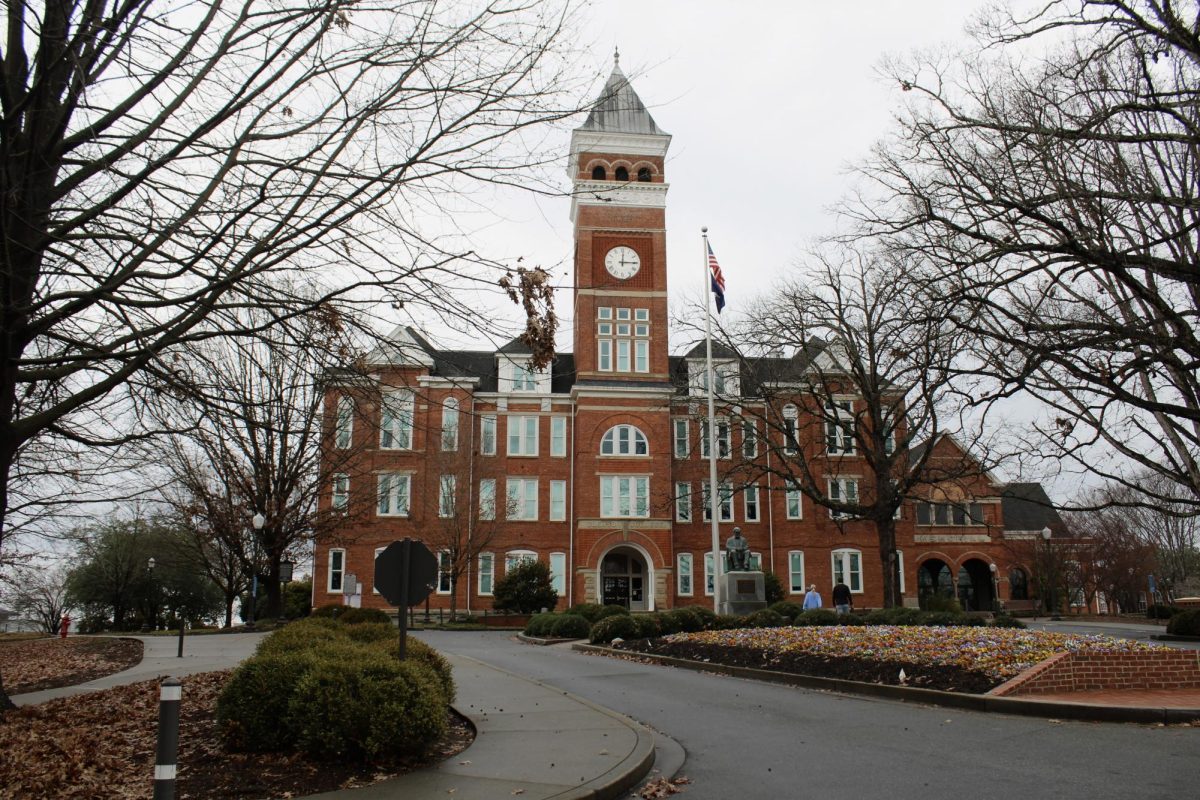
Perhaps the most notable landmark on Clemson’s campus, Tillman Hall, is home to the historic clock tower. The tower overlooks Bowman Field and houses a set of 47 handcrafted bells that can be heard up to a quarter mile from campus.
While the tower is now a central part of campus, it once seemed the building might have been lost forever.
In 1894, a fire destroyed all but the exterior of the building. Rather than leave the building to nothing more than a memory, Clemson immediately began the restoration process. By 1895, the building was back as if nothing had ever happened.
Today, the building that was nearly completely lost now stands as one of the University’s most prominent features.