College campuses are hubs for political discourse and activism, as seen with both the University of South Carolina and Clemson. The two campuses reside in vastly different areas of the state; Clemson is nestled next to the Blue Ridge Mountains in rural South Carolina, while the University of South Carolina is centered in the state’s capital city. However, both share a commonality in their passionate and robust student bodies.
Clemson resides in Pickens County, which covers 497 square miles and has an estimated population of approximately 130,000. 86% of the county is rural, with the remaining 14% classified as urban. Pickens is considered “the reddest county in the state,” according to CountOnNews2. The average margin of victory for Republicans in recent election cycles has been 50.13 percentage points.
Richland County, where South Carolina’s campus resides, has a population of approximately 430,000, covering roughly 750 square miles. It’s known as a major urban center in the state, but it also includes pockets of rurality. Richland is the second bluest county in the state, following Allendale County. Here, Democratic candidates have won by an average of 36.55 percentage points in recent elections.
Looking at the Foundation for Individual Rights and Expression rankings for 2026, South Carolina ranked No. 22 out of 257 colleges and universities for speech climate with an overall grade of C-minus, an increase from a D-plus in 2024. There are roughly 2.12 conservative students for every one liberal student, according to FIRE’s data.
FIRE ultimately gave South Carolina the “green light” for speech.
FIRE ranked Clemson at No. 13, down eight spots from its 2024 ranking, with a grade of C-minus. Clemson’s grade in 2024 was a C. Clemson earned a score of 72, and there are roughly 1.64 conservative students for every one liberal student on campus. Clemson also previously adopted the Chicago Statement for Free Speech, similar to South Carolina.
Clemson additionally received the “green light,” according to FIRE statistics.
The topic of free speech itself has been prominent at Clemson, where three professors were fired for posts regarding the late Charlie Kirk. In response, the American Civil Liberties Union of South Carolina sued Clemson, citing the Chicago Statement for Free Speech in the complaint.
Unique to South Carolina is National Ground Game, a political action committee and organization that serves as an opposition to conservative movements on campuses, specifically Turning Point USA. Executive director Zee Cohen-Sanchez formed the organization after the results of the 2024 presidential election, according to an article by The Daily Gamecock. The organization’s goal is to secure more victories for democrats, and NGG is currently working with 25 different schools to start chapters.
Similar to Clemson, South Carolina’s College Republicans chapter is doing a speaker series with candidates for the upcoming 2026 elections, according to News Editor Colin Elam, but the chapter has hosted fewer candidates than Clemson’s chapter.
Clemson College Republicans has hosted Alan Wilson, Paul Dans and Mark Lynch.
Wilson, an alumnus of the University of South Carolina School of Law, is one of the five Republican candidates running for South Carolina Governor. Dans and Lynch, both Republicans, are running in the 2026 Senate election in South Carolina, challenging current senator Lindsey Graham. Lynch, a Greenville businessman, announced his run for Senate in February 2025, with Dans announcing his candidacy later in July 2025.
South Carolina College Republicans also hosted Dans.
A unique quality of South Carolina’s campus is its proximity to the state capital, which is only a few minutes away from campus.
On Oct. 18, a “No Kings” protest was held in front of the South Carolina Statehouse. Thousands gathered to protest the current presidential administration. The event was organized alongside Indivisible Upstate SC, a local chapter of the nonpartisan Indivisible Project, per The Daily Gamecock.
Protests surrounding the widely discussed SB 323, the “Unborn Child Protection Act,” occurred on Oct. 1 following the South Carolina Senate Medical Affairs subcommittee hearing of the bill. Over 300 South Carolina constituents signed up to speak, according to The Daily Gamecock’s article covering the protests. The bill has since failed to advance from the Senate Medical Affairs subcommittee as of Nov. 18.
Clemson’s campus has seen tabling and speaker events from individuals and outside organizations alike, such as Operation Save America and the Fearless Tour, pioneered by social media presence Cam Higby.
A silent protest occurred at Clemson following the University’s firing of three professors. Individuals held signs that read “Without education there is no freedom” in support of free speech. This followed the lawsuit that the ACLU filed against the University that claimed the unlawful firing of former professor Joshua Bregy.
Wilson commented on the dismissal of professors, stating that the First Amendment protects free speech, but “does not shield threats, glorification of violence, or behavior that undermines the mission of our state institutions,” according to a news release.
Benny Johnson, political commentator and colloquially known as the “Godfather of the conservative internet,” came to speak at the Strom Thurmond Institute on Clemson’s campus on Tuesday, Nov. 18, hosted by Clemson’s Turning Point USA chapter.
He listed the names of the fired professors and stated that they “celebrated the assassination of the founder of this organization,” and further thanked the administration for firing them.
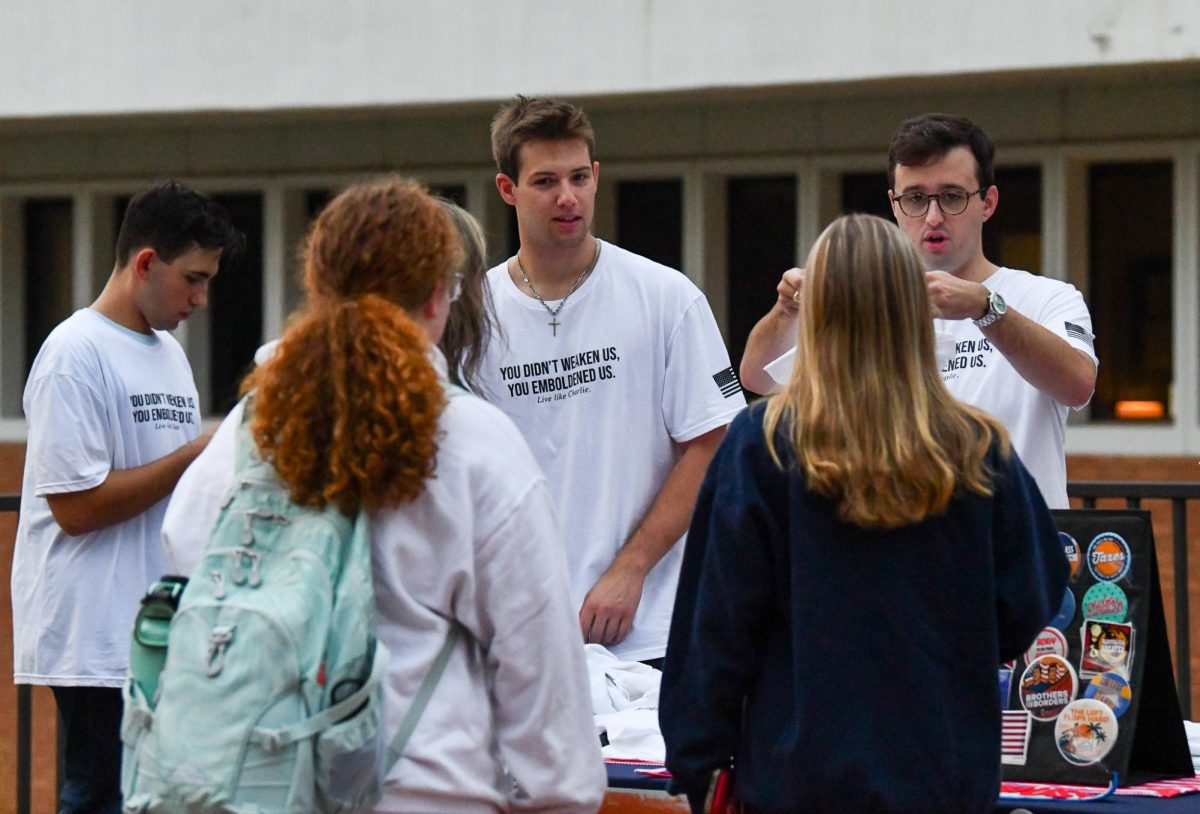
Following Kirk’s death, both campuses have reported on their respective TPUSA chapters and the rapid growth and conversation accompanying it.
Similar to Clemson, South Carolina’s TPUSA chapter hosted vigils in memory of Kirk, which many members of the community attended.
Clemson’s TPUSA chapter has 16,100 followers on Instagram, compared to South Carolina’s TPUSA chapter with 15,400 followers.
Considering political centers and institutes, South Carolina has the Center for American Civic Leadership and Public Discourse. This focuses on bringing scholars, thought leaders and the community together to address “critical challenges facing our state and nation.”
Clemson has the Snow Institute for the Study of Capitalism, which examines the foundations of capitalism through programs such as the Lyceum Program, founded in 2014.