
Over 60 years after its creation, Lake Hartwell serves as a pillar of recreation and college life for Clemson’s student body and the larger Upstate community.
But under Hartwell’s placid surface lies something else entirely: a ghost town. Andersonville, a city forged at the turn of the 19th century, lingers at the bottom of Hartwell — a relic of Southern history.
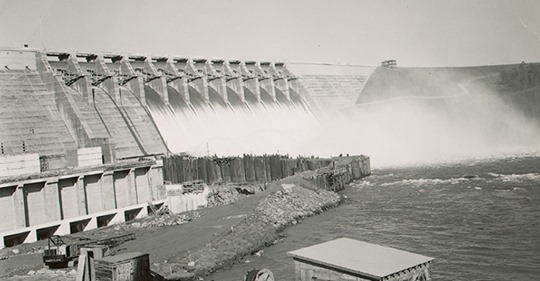
Bordering Georgia and South Carolina, Lake Hartwell is a human-made reservoir created by the construction of the 12,400-foot-long Hartwell Dam in 1962. The dam was built as part of the second phase in the development of the Savannah River Basin, and has been reported to cost between $60 and $100 million. Today, Hartwell covers nearly 90 square miles and has a shoreline of 962 miles.
An estimated 14 million people visit the lake annually, and with numerous public access points, it’s one of the top three most-visited lakes created by the U.S. Army Corps of Engineers.
Andersonville resided in the lowlands of the Savannah River prior to the 1960s, when Lake Hartwell was created. Once the lake was planned, the valley was filled with water, and the town was left to rest at the bottom of Lake Hartwell.
The beginning
Andersonville was established in 1801 and owned by an officer of the American Revolution, Samuel Earle. It was located at the corner of the Seneca and the Savannah rivers. Robert Anderson, the namesake of the town, along with Earle and his relative, Baylis Earle, served as town commissioners.
Later, a United States congressman, Col. Elias Earle, obtained a government contract to supply arms and manufactured guns there. The town was a major distribution center for cotton and experienced economic success due to the ease of transportation provided by the Savannah River.
A June 11, 1885, edition of The Anderson Intelligencer describes the previous economic prosperity of Andersonville, describing it as “quite an important place, as a great many boats were loaded here for Hamburg, and afterwards Augusta.”
In a cruel show of irony, the same river that inspired the possibility of economic prosperity also swept the town away. In 1840, the town was severely damaged by flooding, and then again in 1852, according to research by Clemson alumnus Samuel Snipes, compiled in his exhibit on the history of Hartwell. The town continued to be periodically flooded as it slowly faded into the history of the Savannah River Basin.
Even in the late 1800s, there were written records of hail and flooding. An 1878 edition of The Anderson Intelligencer recounts that in some lowland areas, crops were “washed totally away,” describing the furious rainstorm.
Now, as the town lies at the bottom of Lake Hartwell, you can’t help but wonder if Andersonville was destined to be covered by water.
A solemn dynasty
As referenced in an earlier edition of The Tiger, Lake Hartwell has seen 111 deaths since 1993. There are reports of deaths before the Lake was even created near Andersonville.
An 1843 edition of Southern Christian Advocate, a journal published in Charleston, South Carolina, features a paragraph reporting the “mysterious” body of a young woman, found in the “Tugalo river at a ferry near Andersonville, S.C., by some persons who were dragging for fish.” Even after her burial, no one could identify the woman.
Looking forward over a century from 1843, there are oral accounts of another death during the actual construction of the Hartwell Dam.
Samuel Snipes, a Clemson alumnus who graduated from the University in 2020, conducted extensive research on the history of Hartwell for his senior thesis.
When Snipes interviewed members of the community who remembered when the dam was built, he recalled that there were several accounts of somebody falling into the cement during the dam’s construction and being left to die. Snipes clarified that this is “strict oral history,” as no record has been found of this death occurring.
Ensuing legal battle — 1950-1960s
An extensive debate emerged within the community over the building of the reservoir. Residents who were offered compensation for land rivaled Clemson College, which fought to protect parts of the land that would have been flooded.
According to meeting minutes from a Clemson College board of trustees meeting held on June 11, 1956, it’s cited as the “earnest request of the Board of Trustees … that the Corps of Engineers re-examine the plans and designs for the Dam and Reservoir.” The Corps of Engineers had originally requested that the college surrender all lands below an elevation of 665 feet, which would be covered by the planned lake.
Clemson College counteroffered for 610 feet.
The plans proposed by the Corps of Engineers would have flooded Memorial Stadium and the current football practice facilities.
Years prior, there had been a concluded agreement on the lands, seeking either to divert the river and lower the lake’s elevation or offer monetary compensation. Eventually, Clemson College trustees declared that the land was “irreplacable”, and the damage to the land would be “irreparable.”
At that specific board meeting, Robert M. Cooper, Edgar A. Brown, Robert F. Poole and Francis M. Kinard were all present, the namesakes of several academic buildings on campus.
The Dikes today — where students and residents enjoy an early-morning walk, paddleboard alongside them on the lake or view a classic Clemson sunset — serve as a modern-day reminder of the compromise from a 14-year-long legal battle.
According to William Thompson, who gave some of his account in an archived article from the Independent Mail in 2012, water would be 8 or 10 feet deep in current-day Memorial Stadium. The engineers created a channel to get the water around the dams.
“They rerouted the river to give room for those dams,” Thompson stated. “Anything for football.”
Judge G. Ross Anderson, who in 2012 was one of the last living persons involved in the legal dispute, gave his account in the same article. Judge Anderson was a recent law school graduate in the 1950s and worked for the attorney representing the steering committee pioneering the Hartwell Dam.
At age 83, Anderson stated, “Oh it was bitter … I’ve tried to find it in my heart to forgive them.”
“It was in the court of public opinion, and we won.”
Judge Anderson passed away in 2020.
Community pushback
According to University historian Jerry Reel, the federal government had initially offered to build the college a new stadium, “but the school wanted to keep the football games within walking distance of campus.”
Anderson also stated that, beyond the college, large landowners were against the project. He stated that his uncle was against the project as well, since he owned 100 acres of land.
“I didn’t give a d*mn,” Anderson said. “He got paid extremely well.”
Newspapers published at the time cite reports of families being evicted and their homes bulldozed for resisting the Corps’ wishes.
In 1956, Eliza Brock and her daughter warded off government workers on her property with a rifle. Brock held out three months past the date the 100 acres technically reverted to government ownership, and eventually settled the issue out of court. She was compensated with $6,850 — a sum worth over $80,000 today.
At the time, Brock single-handedly delayed the Army Corps of Engineers’ construction at 73 years old.
A remnant of Southern history, shaped by community disputes and University legal battles, Lake Hartwell’s buried stories serve as a reminder of the region’s complex past. Recent events ignite solemn memories as its history continues to reflect the turbulent narratives of the recreational landmark.