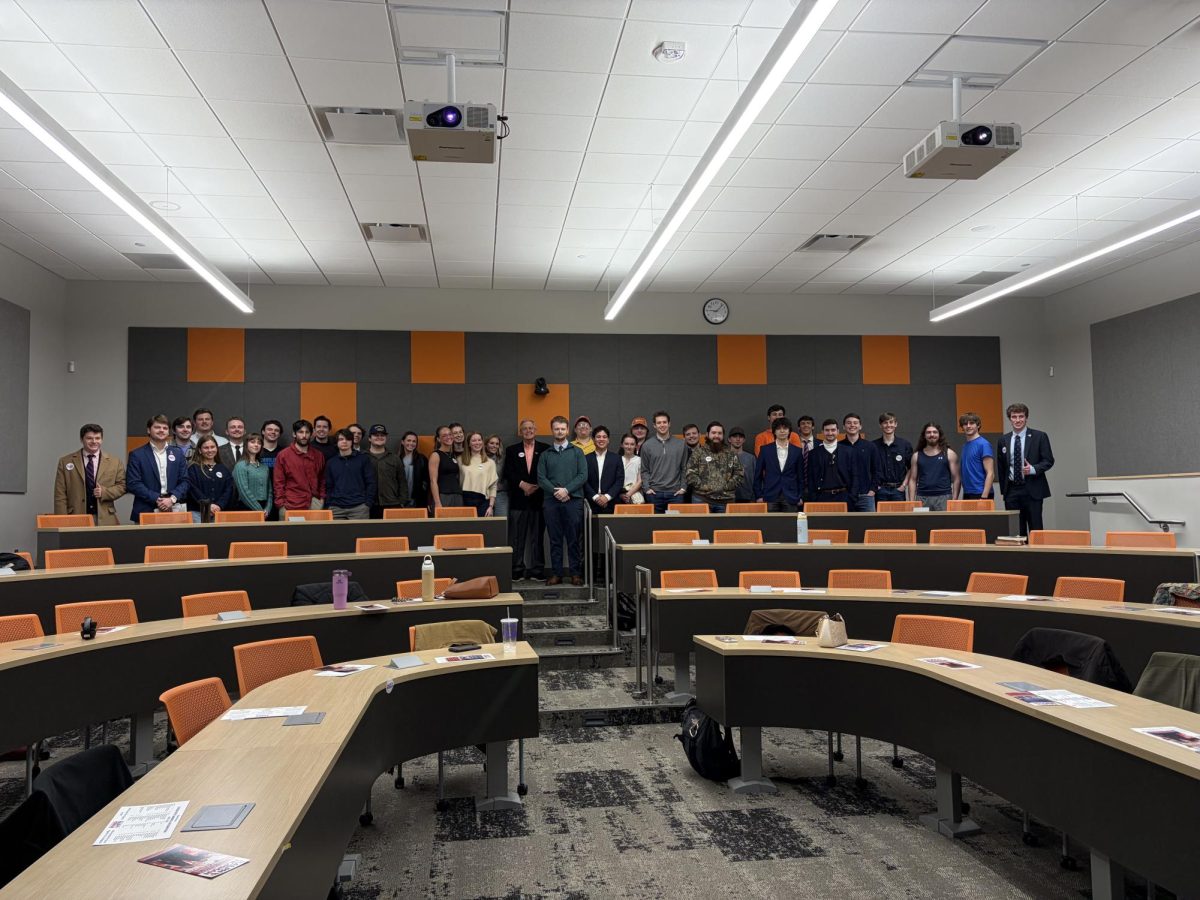


Clemson alumnus and lead defense attorney in the Alex Murdaugh trials, Dick Harpootlian, returned to his alma mater on March 2 to give an account of his career and experiences throughout his time in media, politics and law.
Harpootlian, who is also a former editor-in-chief of The Tiger, former South Carolina state senator and former chair of the state’s Democratic Party, has undoubtedly worn many hats throughout his life. But prior to becoming a famous trial attorney, politician and author, Harpootlian was a normal student at Clemson.
Harpootlian attended a very conservative Clemson in 1966, three years after Harvey Gantt became the first Black student enrolled at the University.
To set the stage, the United States military was stationed in Vietnam, but the war wasn’t at its peak quite yet. Reserve Officers’ Training Corps was required for students at the time, and two-thirds of the freshman class didn’t return due to failing.
“That’s important to understand, because if you didn’t make it back and you didn’t have a college performance, you would go to Vietnam,” Harpootlian said during the event.
There were 42 female students enrolled when Harpootlian arrived at the University. This number grew to comprise half of the student body by his senior year. At the time, however, freshman women had a 10 p.m. curfew every night and faced disciplinary action if they did not comply.
Harpootlian brought up 20-year-old married architecture student Cathy McNeight, who was charged with wearing too short of a skirt. She was convicted by the student court, and acquitted on appeal.
With Gantt’s recent enrollment at the University, which was heavily fought in courts up until an order from a federal judge, there were no Black student-athletes. Prior to college, Harpootlian had never gone to a de-segregated school before.
Harpootlian noted that what college did to him, and what he believes it should do for current students, is “challenge the value and the norms of society.” He explained that if students don’t do so while in college, they never will.
“Clemson shaped me into somebody who always asked, ‘why?’” he continued.
During the summer of 1970, Harpootlian enlisted actress Jane Fonda to speak to the student body, much to the frustration of former President Robert Cook Edwards. Fonda spoke about peace and the Vietnam War directly following a very controversial event in which she’d visited Vietnam. The event caught national attention.
4,000 students gathered at Clemson’s amphitheater to hear from Fonda.
“That was important because most of those kids there did not agree with her, but they heard her,” Harpootlian said.
He participated in at least three anti-war demonstrations that fall, which included speakers such as CBS News reporters who went to Southeast Asia in World War II.
Harpootlian also discussed the civil rights movement, which was very prevalent at the time. In 1968, several SC State students told The Tiger in an interview that three of their own had just been killed for attending an all-white bowling alley.
Six weeks later, Martin Luther King Jr. was killed, and The Tiger went to participate and cover his funeral.
The Tiger was dedicated to covering these national and world-wide events, according to Harpootlian.
“We made sure you knew about it, even if you didn’t want to know about it,” he said.
Identifying himself as a pro-death penalty and fiscally conservative Democrat, Harpootlian encouraged people to have faith in the country. He said that, most of the time, people correct their mistakes.
“I’m not a fan of the current President of the United States … but I’m a fan of the presidency … the institution,” Harpootlian told the crowd.
He also spoke about his relationship with former President Joe Biden.
“I’ve known Joe Biden for 30 years. He was at my house last Friday,” Harpootlian said.
Harpootlian stated that Biden was a “great human being,” but that doesn’t mean he was the best president.
He also encouraged the students and faculty to engage in their communities, to not let themselves be pitted against their peers nor “go into life predisposed to be a Democrat or Republican.”
As far as the dissemination of information in the modern world, Harpootlian encouraged students to read opposing viewpoints and trust reputable sources. He said he reads the New York Times and Wall Street Journal every day, underlining the importance of reading multiple news outlets.