
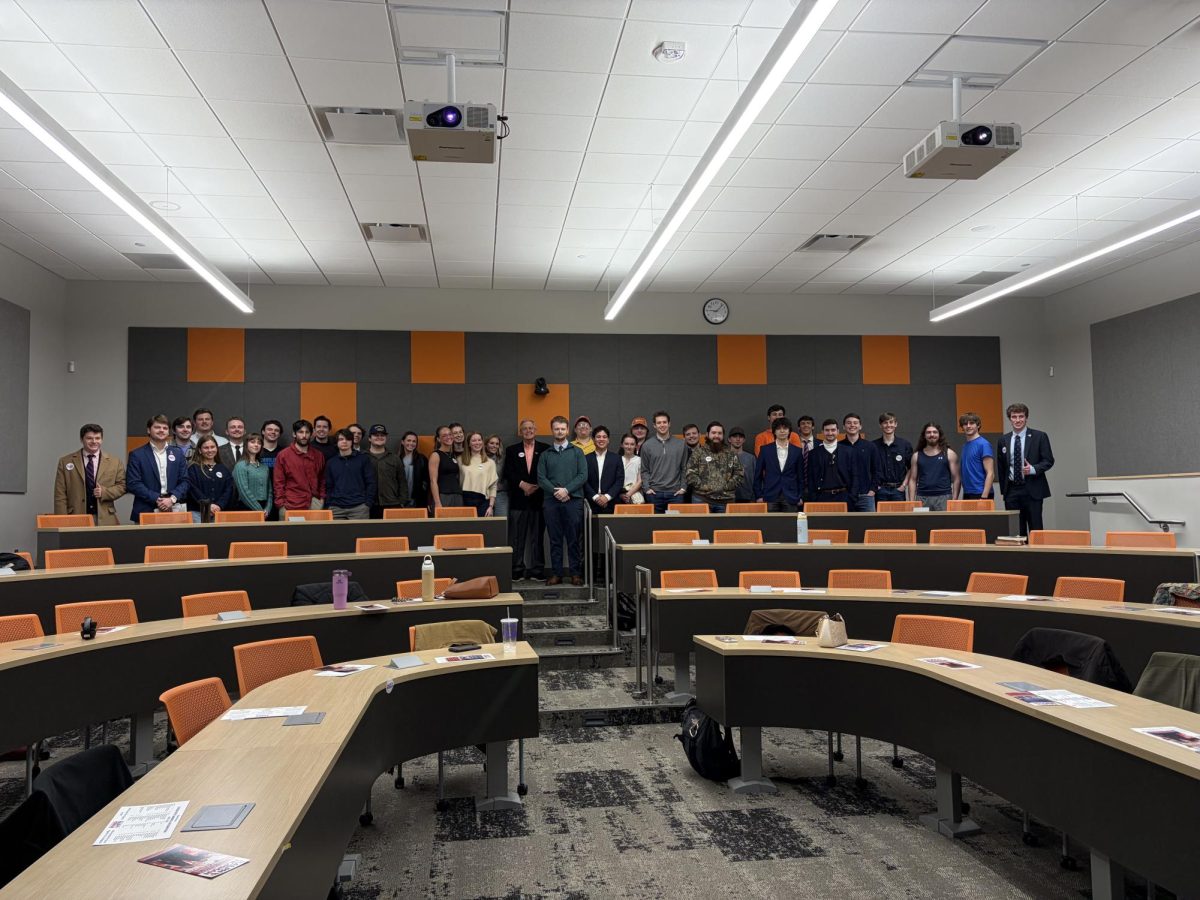
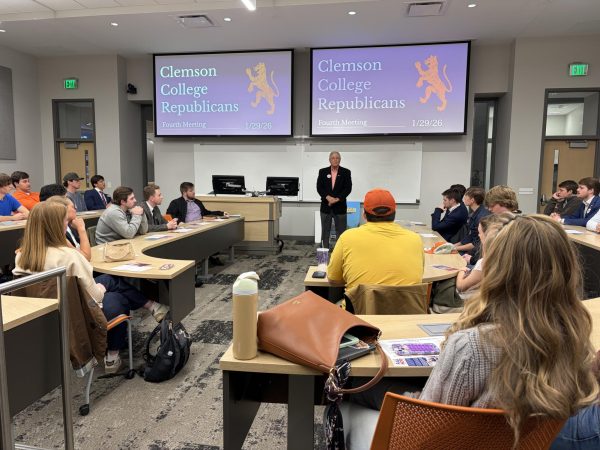
Clemson College Republicans hosted Ralph Norman, a South Carolina congressional representative running for governor, on Thursday, Jan. 29
Currently, Norman serves as South Carolina’s representative for District 5. He has been in the congressional office for eight years.
Norman began the event by establishing that he is not a “career politician,” as he ran in a 2017 special election after the incumbent, Mick Mulvaney, resigned.
Before entering office, Norman joined his father in his construction business, which he helped turn into “one of South Carolina’s most successful commercial real estate developers,” according to his website.
Norman is running for governor because South Carolina is important to him, and when he saw who else was running, he said he’s “got to do this.”
“I think the brightest days of South Carolina are ahead of us, with good, strong leadership to change the system,” Norman said. He advised students to “pick up the mantle to protect this state.”
Political climate on college campuses
Norman said he believes that if the United States were currently under the authority of Kamala Harris or Joe Biden, we “would have lost our country.”
He drew attention to younger individuals who should be politically involved and have the courage to speak out.
“A lot of students are scared to say anything. Either they will get a bad grade from their professor, or there’s ramifications if they don’t write a paper that suits what the professor believes,” Norman said.
He also does not believe in tenure because it allows professors to stay at universities as long as they want. Norman said he was very vocal when three University faculty members were “mocking” conservative political activist Charlie Kirk after he was fatally shot in September. The faculty members posted and reposted several controversial statements about Kirk on social media, which Norman took offense to.
He believes that higher education teachers and people in general need to be held accountable for their actions and words.
“We’ve got to get our voice back,” Norman continued.
Term limits
Norman believes there should be an established term limit on how long someone can be in office. He wants to consider a bill that limits people’s ability to continue campaigning for seats in Congress.
One example he gave to the group was that former President Biden had been in politics for about 50 years.
“There’s no reason for politicians to go out to Washington and spend the rest of their lives there. Go work under some of these laws that you make,” he said.
Roads
One student mentioned that near his South Carolina home, the state removed a road due to structural issues and that there is still no plan to rebuild it. He asked Norman what his plans are to fix the current road issues.
Norman responded that he’s unaware of what the maintenance plan is for these types of roads at this time; however, he noted that the state’s current solution for these issues seems to be just throwing “asphalt in a pothole.”
He wants to make sure that this plan does not stay in place. If elected, he would find out “how much goes to asphalt and construction” to address the issue.
Education
Norman wants to establish merit-based pay for teachers. He explained that “you have one shot at educated children” and would like the “dollar to follow the child.”
He told the group about his experience attending an academy in Charleston, where the students had uniforms and phones in the hallway during class time.
He discovered by speaking to teachers who spent “extra time with students” that those students ended up having higher standardized test scores. Norman wants these types of teachers to be paid more.
Another student questioned his concerns about students coming from the “Middle East, India and China,” and wanted to know what Norman might do to “prioritize American students and South Carolina students.”
He responded that at one point, “China was paying top dollar to the universities and putting them in Carolina, Clemson and all of the big schools. What they were doing was coming under the guise of going into engineering and some of the specialized fields.”
Immigration
Charlie Clontz, president of Clemson’s Turning Point USA chapter, brought up Minnesota and its “refusal to work with ICE and federal law enforcement in order to help their facilitation deportation efforts,” then asked, “under your leadership, what would state and ICE … cooperation look like?”
Norman said he sympathizes with ICE agents, as “they have to get beat up every day.” He believes that individuals must face consequences for refusing to work with agents, including even jail time.
“Law enforcement is going to be a big part of my administration. I want to support law enforcement because if y’all aren’t safe here on the Clemson campus, it kind of negates everything else,” he said.
Abortion
Norman explained that he is pro-life and that if a general put a bill on his desk that was the “most strict pro-life bill,” he’d “sign it now.”
“It’s been a divisive issue, because what’s magic to kill a child, is it 13 weeks? Is it 20 weeks? No, not for life. A child has a chance, needs a chance, we all have a chance,” he told the group.
Marijuana
One question was raised about President Donald Trump’s recent reclassification of marijuana from a Schedule 1 to a Schedule 3 substance, and whether Norman would maintain the laws that currently restrict South Carolina citizens’ usage of the substance.
Norman responded that he disagrees with Trump’s reclassification and that he would not change the laws because “marijuana is a gateway drug.”
“I don’t think that’s right,” he continued.