
Over the past decade, Clemson professors have been studying and researching missing persons and human trafficking cases in the state of South Carolina.
In 2025, the South Carolina Law Enforcement Division reported over 300 tips of human trafficking across South Carolina, according to the South Carolina Attorney General’s Human Trafficking annual report. The annual report noted that SLED discovered 323 victims, 234 of whom were minors.
As of 2026, there are 291 open missing cases, and 359 that have been resolved, per World Population Review.
Two Clemson professors explained that in most abduction cases, the human trafficking trade is a possibility. However, abduction does not mean the individual will be trafficked in South Carolina.
In 2018, Thomas Sharkey, Ph.D., a Clemson professor in the department of industrial engineering, began studying the impact of including lived experience in human trafficking research, according to Clemson News.
Over a six-year span, Sharkey has led a team of researchers to learn, develop models and create tools to help others understand how trafficking networks operate from the inside by using real survivor stories.
Sharkey explained to The Tiger that there are incidents of stranger abductions or kidnappings that can lead to human trafficking; however, he noted that “it is much more common for domestic victims (U.S. citizens within the U.S.) to be trafficked by an individual that they have previously been in contact with.” He elaborated that the trafficker could even be a family member.
Coercion and manipulation are frequent ways traffickers will interact with their victims and later use to recruit them into trafficking, according to Sharkey.
In general, human traffickers are able to identify vulnerability by noting things such as unstable housing, substance abuse and food insecurity, Sharkey explained. The perpetrators will use these vulnerabilities to change their manipulation tactics.
“Runaways often have an underlying susceptible — like needing housing — that traffickers could leverage in their trafficking,” Sharkey said.
The research article that Sharkey contributed to explained that its results and research methods emphasize “lived experiences in sex trafficking” along with “computational modeling of sex trafficking.”
The models highlighted in the article include youth susceptibility to trading sex along with forced criminality.
The first model demonstrates a before-and-after perception of human trafficking among minors. The before shows what “academic expertise” the group had, versus the after, where they had included “lived experience expertise.”
Before, the reader can see a smaller scale of just susceptibility, with individuals who have never traded for sex versus those who have. It then expands to incarcerated and other institutionalized individuals with exit points, including potential death.
Next, they created a visual overview of forced criminality that follows the same before-and-after pattern as in the first model, both before and after speaking with survivors.
The researchers originally thought that the market sections where the victims would be placed would be high-end commercial sex, low-end commercial sex, illicit drugs, fraud and theft or shoplifting, with a total of eight hours of work per day.
The after model shows an expansion to strip clubs, nickel and dime commercial sex, escorting, illicit drugs, fraud and theft or shoplifting, with a total of 12 hours of work per day.
Both models demonstrate misconceptions from an academic perspective versus a real-life individual who experienced human trafficking.
Kristin Lloyd, Ph.D., an assistant professor in the department of sociology, anthropology and criminal justice, teaches ANTH 6850 (JUST, SOC): Atrocity Crimes.
Lloyd told The Tiger about the findings within the United States Attorney’s Office for the District of South Carolina. The AOSC had prosecuted seven human trafficking cases within the state in 2025, which “included 17 defendants and at least 25 victims under federal charges.”
She also noted that South Carolina court data showed that in 2025, 32 human trafficking charges were closed. Of those charges, it involved 17 defendants in 13 counties, “including Anderson (1 person) and Greenville (5 people) Counties.”
After explaining these statistics, Lloyd noted that “these are very small numbers relative to other states and other nations, but there are a few reasons that could be.” She provided a few examples as to why South Carolina’s number might be smaller.
First, trafficking is a hidden crime, often occurring in “private facilities, businesses and residences,” making it difficult to identify. Second, Lloyd said that “many people are unaware of how to identify human trafficking.”
She elaborated that people have a perception that someone working for the trafficking trade will “leave a note on your car and when you grab it to read it you’re going to be abducted and forced into some form of labor or sex. But this isn’t a reality,” she said.
Next, Lloyd explained what human trafficking may look like: “It’s almost always a stepwise process where traffickers lure, groom, and coerce a person into the situation.”
Lloyd also highlighted the connection between vulnerable populations and trafficking. She used an example of a state report that found 56 juveniles who were identified as trafficking victims had a history of a justice contact.
One document that Lloyd brought attention to, created by the Attorney General’s office, explained that there is a lower percentage of individuals who are trafficked through abduction.
“There is a pretty common misconception that most people are trafficked via abduction, but that actually accounts for about 3% of all human trafficking cases in SC.”
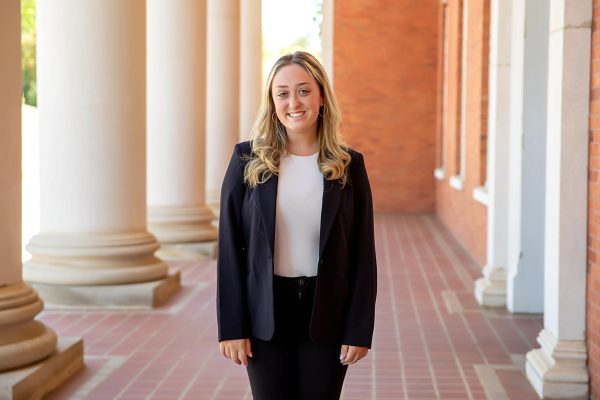
Olivia Theo, a student in Lloyd’s Atrocity Crimes course and a senior political science major, explained what students learn in class.
“So many important aspects of human trafficking have been addressed in class. The most notable being the nature in which it can occur,” Theo explained.
Within the class, students learned that a large number of trafficking cases are not reported due to the appearance of normalcy to the public eye. “It is not always blatant kidnapping by a random offender,” Theo said.
She believes that human trafficking is an issue within South Carolina, mainly due to the cases going widely underreported.
Theo also believes that missing individuals could potentially correlate with human trafficking.
“Human trafficking rates have significantly increased not only in SC but across the nation in the past 4 years, so it would not surprise me if there were a correlation,” she told The Tiger, also emphasizing that escalation of the crime is inevitable if it’s not properly addressed.
Lloyd said that all survivors deserve justice and victim services.
“One case of trafficking is too many, and the state’s Solicitor’s Offices and the Department of Justice are dedicated to eliminating human trafficking,” she continued.